Impressions are a receipt, not a result
Exeter Chiefs published something genuinely useful last week.
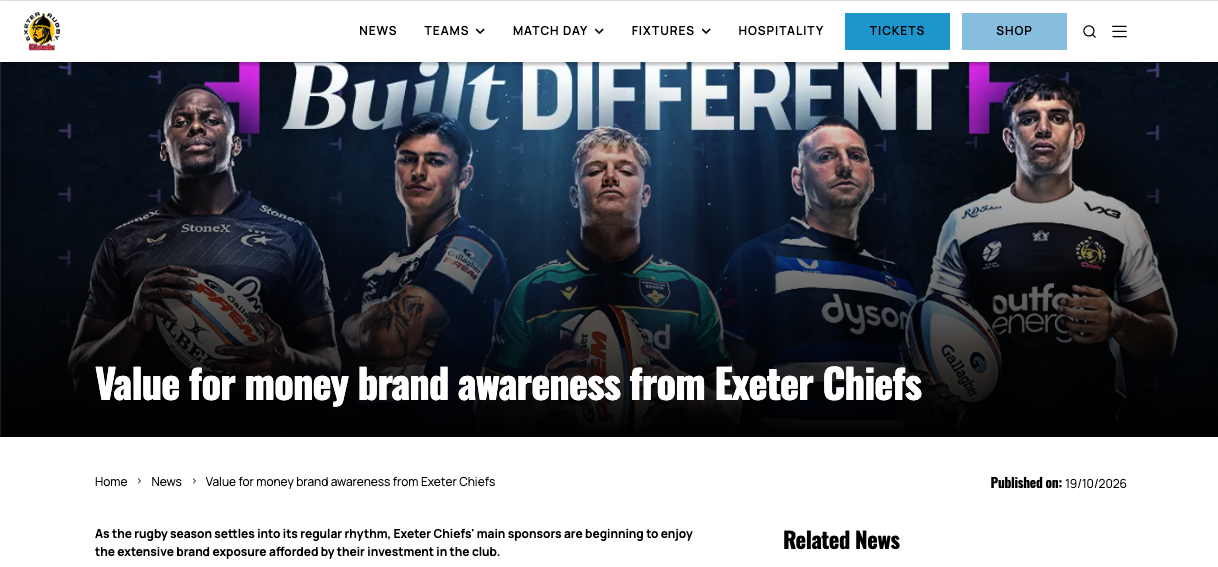
It’s a clear-eyed breakdown of what a shirt sponsor actually gets: the TNT teaser for the Gallagher PREM season that put front-of-shirt partner Outfox Energy in front of a cumulative audience of 10.3 million. Newspapers, posters, signage, merchandise, website, social. And the headline number - Nielsen data showing kit sponsors picked up 178 million social media impressions across last season, which the club puts at around £3 million of equivalent media spend.
Their head of commercial, Colin Woods, makes the case straight: “Being a shirt sponsor is not just a nice-to-have for a business, it represents real value in terms of multi-media brand exposure and a tangible return on investment for marketing budgets.”
Most clubs couldn’t articulate it that well. Credit where it’s due.
Here’s my problem with it, and it isn’t a problem with Exeter.
For a very large number of the businesses reading that article, 178 million impressions is a completely wasted metric.
Not wrong. Not inflated. Wasted - because an impression is only worth something if it meets an objective you’ve actually set, and if you have a mechanic that converts attention into something meaningful. Strip those two things out and you haven’t bought a result. You’ve bought a receipt that proves the money moved.
The metric everyone quotes and nobody can use
Media value equivalency is the most quoted number in sponsorship and the least useful one in the room.
It answers a question nobody in a boardroom is asking: what would it have cost to rent this much attention? The question they are actually asking is: what changed in our business?
The gap between those two is where most sponsorship money quietly dies.
Here’s the test. Take the 178 million figure and try to finish this sentence on behalf of one of the sponsors: “As a result of those impressions, we…”
If the honest answer is “…were seen,” you haven’t got a campaign. You’ve got a sponsorship.
And notice what the metric does to the conversation. A number that big is designed to end discussion, not start it. Nobody interrogates 178 million. Nobody asks which 178 million, how many were the same forty thousand people seeing the same badge on a sleeve twenty-two times, how many were sub-second scroll-past, how many were in a market the sponsor sells into, or how many belonged to a demographic that could plausibly buy the product.
A regional roofing firm doesn’t need 178 million impressions. There aren’t 178 million roofs within driving distance of the depot. It needs about four thousand of the right ones, repeatedly, with a phone number attached.
That isn’t a criticism of the club. The club is selling the asset it has, and selling it honestly. It’s a criticism of how the buy-side evaluates it, which is usually not at all.
Reach is the cheapest thing in the room
Here’s the uncomfortable bit for sponsorship sales teams.
Awareness and reach are the first real challenge any new business faces. Everybody needs to be seen before anything else can happen. But in 2026, raw exposure is the single most commoditised, most biddable, most oversupplied input in marketing.
You can buy attention at a lower unit cost through smart paid media than almost any sponsorship will deliver it. You can earn it organically, at zero media cost, if you build something people want to pass on. You can buy a creator with a tighter, more relevant, more trusting audience for a fraction of a shirt deal. The infrastructure for renting eyeballs has never been more efficient or more accessible.
So if a club’s pitch is fundamentally we will get you seen, it is competing in the one category where it has no structural advantage and a significant cost disadvantage.
Which means the interesting question isn’t “is sponsorship good value per impression?”
It’s: what can a club give you that a media buy can’t?
Because that - not reach - is the actual product. And almost nobody buys it deliberately.
What you’re actually buying: borrowed belief
Woods names it in the same article, and this is the part worth taking seriously:
“There is also credibility by association; the kudos of being aligned with a rugby club like Exeter Chiefs… Put simply, a shirt sponsor adds gravitas to a business’s image.”
He’s right that this is the real asset. Proximity to something people already trust, in a category where trust is the binding constraint. A roofing firm, an energy supplier, a law firm, a recruiter - all selling things where the buyer’s main fear is being had. Standing next to an institution the buyer’s family has supported for three generations does genuine work on that fear. No amount of paid social does the same job.
That’s the thing a media buy can’t replicate. It’s also leaking.
Consumers are considerably more sceptical of paid partnership than they were ten years ago, and they’ve been trained to be. Disclosure rules made the commercial relationship visible. A decade of influencer marketing taught everyone to read the room. “Official partner” now reads, correctly, as “paid for this.”
Which brings us to Dave.
Are we honestly meant to believe that every member of staff and every player had a brilliant personal experience with Dave’s Roofing Services, and that’s why a professional sports club is willing to lend Dave its reputation? That the fee had nothing to do with it?
Nobody believes that. Including Dave.
And here’s the thing: that doesn’t make the credibility worthless. It makes it conditional. Borrowed belief transfers when the audience can see a reason for the relationship beyond the invoice. It doesn’t transfer when the only visible logic is money.
So the question for any sponsor stops being how many people will see our logo and becomes why would anyone believe this pairing makes sense?
If you can’t answer that in one sentence that doesn’t mention the fee, the credibility isn’t going to transfer. You’ll have bought visibility and called it endorsement.

Read more about partnerships on the First Five Blog
Risk, resource, reward
I say this to anyone who’ll sit still long enough: partnerships share risk, resource and reward. If all three aren’t shared, it isn’t a partnership. It’s a transaction you’ve given a nicer name.
That test is unglamorous and it’s brutally effective. Run it over any sponsorship on the table.
Risk. Who loses if this doesn’t work? If the club banks the fee regardless of outcome and the sponsor carries all the downside, there’s no shared risk - and therefore no structural reason for the club to care whether anything converts. Shared risk looks like performance elements, multi-year terms with review gates, co-invested activation budget, or a club putting its own resource behind the thing that makes the sponsor’s business work.
Resource. What is each side putting in beyond money and inventory? A sponsor who writes a cheque and waits has bought signage. A club that hands over a logo placement and moves on has sold signage. Shared resource is access to players for something that isn’t a photo, data the sponsor can act on, a club’s community team opening doors, the sponsor’s product solving a problem the club actually has.
Reward. Does success look the same to both parties? This is where most deals are quietly broken from day one. The club’s definition of a good season is renewal. The sponsor’s is pipeline. Nobody ever writes both down in the same document, so nobody is ever accountable to the other’s number.
Most sponsorship fails the test on all three, and everybody involved is slightly relieved, because sharing risk means someone might be found out.
Dave buys a shirt: a worked example
Let’s actually run it, because abstractions are easy to nod at.
Dave’s Roofing Services is a thirty-person regional roofing firm. Good reputation, mostly word of mouth, two problems: domestic leads are seasonal and lumpy, and he cannot hire qualified roofers fast enough. He’s offered a sleeve and some signage.
The version that wastes the money. Dave buys it because it feels like an arrival. The logo goes on, the club posts a welcome graphic, Dave’s wife sends it to the family WhatsApp. End of season, the club reports a share of X million impressions and a healthy media-value equivalent. Dave can’t tell whether a single job came from it, so he renews on instinct and a slightly smaller feeling. Three years in, it’s a line in the overheads nobody questions and nobody can defend. The club thinks Dave is happy. Dave thinks sponsorship doesn’t really work.
The version that earns it. Dave starts with his actual constraint - hiring - and buys against that. The headline asset isn’t the sleeve, it’s a recruitment mechanic: club-hosted trade apprenticeship open days at the ground, Dave’s roofers running the sessions, the club’s channels carrying it to exactly the local demographic Dave hires from. The sleeve becomes credibility that makes the open day feel legitimate rather than the thing he’s paying for.
Second mechanic, and it’s small: a trackable offer for season-ticket holders, in the matchday email, with a dedicated number and a code. Not glamorous. Attributable. Now Dave knows what a lead from this costs.
Third, he uses the hospitality properly - not as a reward for himself but to get his four target commercial contractors in a room where they’re relaxed and he’s the host rather than the supplier.
Same fee. Same sleeve. Entirely different purchase.
And notice what the club has to do differently in version two: give access, co-build the open days, put its community team on it, carry the offer in owned channels. That’s shared resource. If the club won’t, that tells Dave something important before he signs - and it’s better to know in the meeting than in year three.
The other half of this: you’re wasting your exclusivity
Everything above is the buyer’s view. There’s a mirror image that rights holders should find more uncomfortable.
Exclusivity is finite. When you sell your front-of-shirt, your category rights, your community-programme naming, you are spending something you cannot get back for the length of that deal.
If you sell it to a business that has no mechanic, no shared objectives and no capacity to leverage it, two things happen. The obvious one: they get a poor result and eventually leave, and you’ve lost a renewal. The expensive one: for every year of that contract, you could not offer that same exclusivity to someone who was ready to use it.
That’s the real cost of a badly matched sponsor, and it never appears in anyone’s commercial reporting. You can’t see the deal you didn’t do.
So the qualification question for a rights holder isn’t can this business afford us. It’s can this business use us - and if the honest answer is not yet, the commercially literate move is to sell them something smaller, prove the mechanic works, and keep the exclusivity in reserve for someone who’ll make it famous.
Selling the crown jewels to the first bidder who can pay is not a commercial strategy. It’s a cashflow strategy. They’re not the same thing and the difference shows up three years later.
Three questions before you buy anything
If you take nothing else from this, take these. They work on a shirt deal, a sleeve, a stadium naming right or a two-grand matchday board.
1. What behaviour am I trying to change, in whom? Not “awareness.” A behaviour, in a named group. If you can’t say it, you’re buying exposure and hoping.
2. What’s my mechanic? What specifically converts attention into the thing I actually need - a lead, an application, a trial, a meeting, a retained customer? If the mechanic doesn’t exist yet, build it before you buy the attention. Attention with nowhere to go is the most expensive thing in marketing.
3. Could I buy this attention cheaper somewhere else? If yes, and reach is all you’re getting, don’t buy it. Buy the thing a media plan can’t sell you - belief, access, community, proximity - and only buy the inventory you actually need to activate it.
Then run risk, resource and reward over the deal. If it fails all three, you’re not entering a partnership. You’re funding one.
This industry can do something no other industry can
I’m not making an anti-sponsorship argument. The opposite.
I genuinely believe the sports industry is uniquely set up to connect and move communities in ways no other industry can. No other sector has that kind of inherited loyalty, that density of shared identity, that permission to turn up in people’s lives every week for decades. You cannot build it from scratch and you cannot buy the equivalent anywhere else, at any price.
Which is exactly why it deserves better than being priced by the impression.
Treating that as an audience to be measured rather than a community to be moved is the single biggest waste in the business. It undersells what clubs have, it disappoints the businesses that buy it, and it keeps the whole category stuck arguing about media value equivalency while the actual asset sits there, undersold, in plain sight.
Get the objectives shared. Get the trust and the understanding deep enough that both sides can be honest about what’s working. Buy only the inventory you need. Sell your exclusivity to someone who’ll use it.
Then the impressions will take care of themselves - and you’ll stop needing them to be the point.