Take two people. Both sit in the same segment on your dashboard. Both register as roughly one owned interaction a week. Both are labelled “casual.”
Person A watches one highlight clip a week. Ten minutes of something that already happened, served by an algorithm, forgotten by lunch.
Person B checks their team’s result every morning before work. Twenty seconds, on a third-party app, alone, out of low-grade anxiety about whether it went well.
Person B is not a deeper version of Person A. They are a completely different animal - and B’s most revealing behaviour is invisible to you by design, because it happens somewhere you don’t own.
Most rights holders define fandom by frequency. Engages roughly once a week. It’s operationally convenient and strategically almost empty, because it measures the wrong axis.
Frequency tells you how often somebody shows up. It cannot tell you whether they seek the unfolding story or care which way it resolves.
Those are the only two things a strategy can actually change!
What Attention Is Actually Doing
The difference between A and B isn’t volume or intensity. It’s what their attention is doing, and whether the outcome matters.
Looking back is a search for entertainment. Highlights, results, compilations, stories from something already resolved. It’s served rather than sought, it happens after the event, and it lives on your own platform because that’s where it’s pushed.
Looking forward is a search for awareness. Fixtures, previews, team news, projections, the next chapter of a story still unfolding. It’s self-initiated, it happens before the event, it repeats - and critically, much of it happens on somebody else’s platform. Odds, fantasy, stats, forums.
That forward attention matters enormously. But it does not prove depth on its own, and this is where most models go wrong.
A fan can want to know what happens next while remaining completely indifferent to how it turns out.
So there’s a second question, and it’s separate: does this person merely want to know what happens, or do they need it to go a particular way?
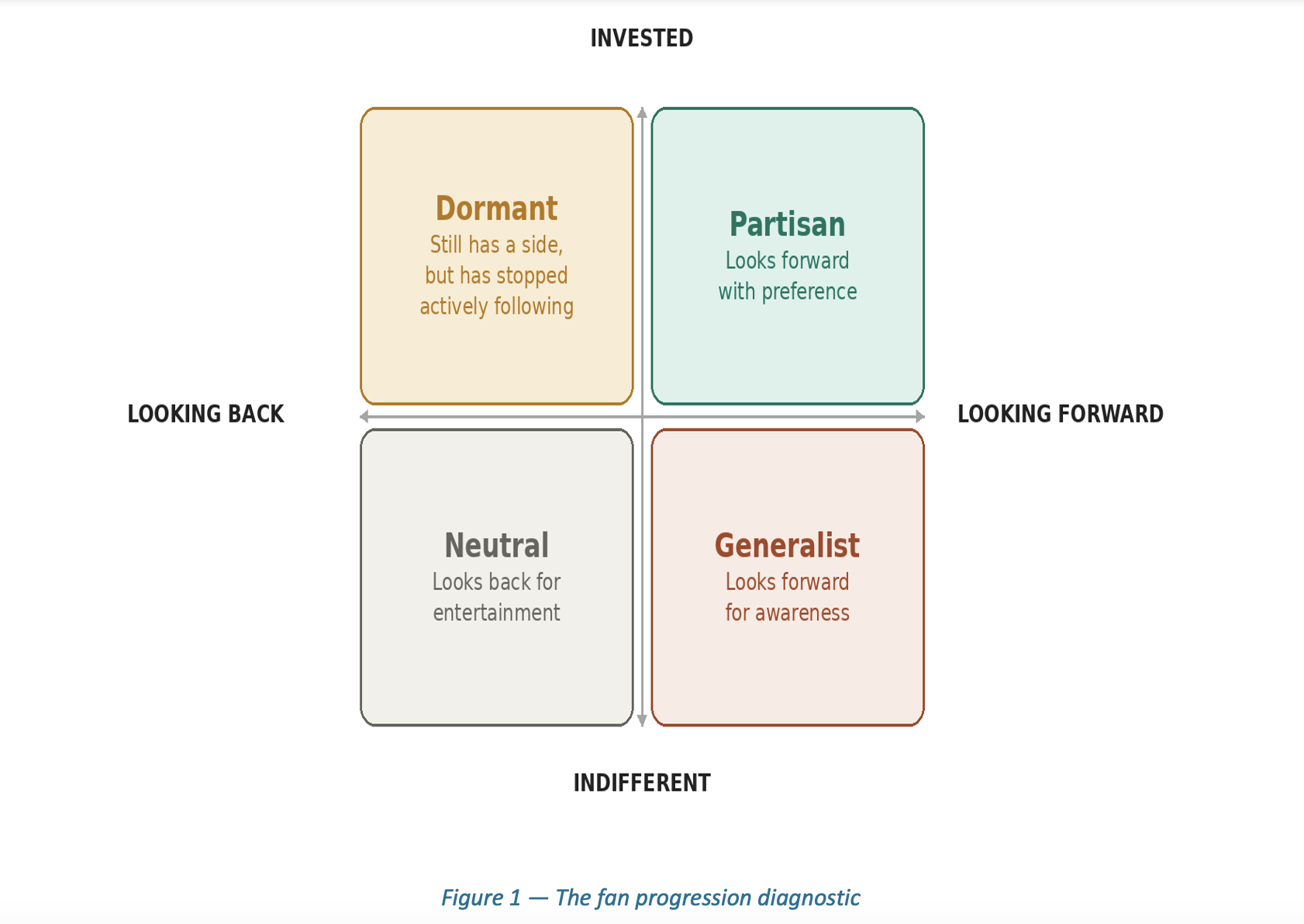
Two axes. Where attention points, and whether the outcome matters. Between them they produce four recognisable fan states that frequency cannot distinguish at all.
Neutral - looks back for entertainment. Enjoys what happened, indifferent to what’s next.
Generalist - looks forward for awareness. Wants to know what’s coming, but has no side.
Partisan - looks forward with a preferred outcome. Needs it to go a particular way.
Dormant - still has a side, but has stopped actively following.
That last one matters more than it looks, and I’ll come back to it.
The Blind Spot in Your Measurement
Here’s the uncomfortable consequence, and it’s the reason this isn’t an academic distinction.
Most owned-media measurement is systematically blind to the thing it’s meant to grow, and systematically flattered by the thing that doesn’t matter.
Checking a result alone, unprompted, on a third-party app, out of low-grade anxiety - that is close to a perfect attachment signal. It’s prospective, habitual and emotionally motivated. Everything you want.
It generates no owned engagement whatsoever.
An autoplaying highlight, watched passively and forgotten by lunchtime, registers as a full engagement event.
So deep fandom can be quieter than shallow fandom. A committed fan may be worth considerably more commercially and register as less on your dashboard than someone who will never convert to anything.
Any tier definition built purely from owned engagement will mis-stage exactly the fans it most needs to find. You will systematically under-value your best people and over-value your worst, and your reporting will look healthy the entire time.
What Actually Moves Someone
The diagnostic describes four relationships with sport. It doesn’t say what moves anyone between them.
Here’s the proposition the whole framework rests on: fandom deepens when a fan moves from neutrality to preference, and makes that preference consequential through commitment.
Three things produce that shift. None of them is content.
Commitment - something at risk. A prediction made. A position taken publicly. A fantasy selection. An argument had in a group chat. Without possible loss there is no emotion, and without emotion nothing gets encoded as a memory worth having.
Declaration - said out loud. A public statement is a small, irreversible act. And irreversible acts generate their own defence - once you’ve said it, you have a reason to want to have been right.
Witness - someone else knows you’re in. This appears to be the largest single effect available. The research I’ve seen suggests the probability of high passion sits at roughly 12% with nobody else in your circle, around 24% with one person, and somewhere near 80% surrounded by several.
A fandom nobody witnesses has nothing holding it in place.
Treat those three as one mechanism with three stages rather than three separate levers. Declaration is how a commitment becomes visible. Witness is what holds it there.
Which means the highest-leverage interventions available to a rights holder are not content formats at all. They are mechanisms that get somebody to commit publicly, at low cost, in front of at least one person they know - and then make that commitment resolve in public.
It’s a Threshold, Not a Ladder
Now the structural point, and it’s the one I’d fight hardest for.
This is not a ladder with evenly spaced rungs. It’s a phase change, and it runs one way far more easily than the other.
Below the threshold, more exposure produces more attraction and nothing else. Water gets warmer. It does not become ice by getting warmer in a straight line.
A thousand highlight clips is still a thousand highlight clips.
You cannot reach attachment by adding attraction, however much of it you add.
And the second feature matters as much as the first: the relationship is asymmetric.
Highly identified fans barely distance themselves after a defeat. They stay through losing - which is, operationally, the entire definition of what a fan strategy is trying to create.
Attracted fans simply evaporate.
The curve going up and the curve coming down are not the same curve.
The practical consequence is about what gets measured. A ladder invites conversion percentages between evenly spaced steps, which feels rigorous and tells you nothing. A threshold model forces the harder question: what makes an aware but neutral generalist take a side?
You Guessed It, I’ve Identified Five Tiers
Tier language - uninterested, interested, casual, engaged, core - is still useful, provided the tiers are placed by those two axes and not by frequency.
Plotted properly, they trace an L-shape rather than a straight line.
Uninterested > Interested > Casual is horizontal movement. From no attention, through retrospective entertainment, towards prospective awareness. This is where most budget sits and it’s legitimate work.
Casual > Engaged is the bend. The fan takes a side and the outcome starts to matter. Generalist becomes Partisan.
Engaged > Core consolidates it through declaration and witness. The preference becomes public and somebody else knows.
Volume can move a fan towards the bend. It cannot make the crossing.
There Is However A Constraint Layer
One correction to apply before you act on any of this.
Some fans hold a genuine commitment and prospective attention but get tiered lower than they actually are - because of access, cost, isolation or literacy barriers rather than lower interest.
A fan checking scores obsessively on poor connectivity, in a market with no local fan community, showing up anyway, is evidence of a stronger underlying commitment, not a weaker one.
Weight constraint-adjusted intent up. Never down.

What It Means If You’re an Athlete
The same mechanism applies to a personal brand, with one structural difference worth naming.
For a club, the Player door is one of three entrances. For an athlete, you are the door - which sounds like an advantage and is mostly a vulnerability, because a following attached to a person has no institution holding it in place when the person stops performing.
Which makes declaration and witness disproportionately important. A follower who has publicly said they back you, in front of people who know them, is in a materially different relationship to you than one who watches everything you post and has never mentioned you out loud.
The practical version: the most valuable thing you can build isn’t reach, it’s a reason for somebody to commit to you in front of their own audience. A prediction about you. A pick. A stake in an outcome you’re part of.
Most athlete strategies are built entirely on attraction, which is exactly the thing that evaporates.
Where To Build First
If you take one operational decision from all of this, take this one.
Across a portfolio, the highest-leverage build is almost always the Casual > Engaged mechanism, because it’s the only transition that creates the thing every later transition depends on.
You need a reason for a fan to take a side that is cheap in time, cheap in money, cheap in social cost - and which genuinely resolves. A prediction. A pick. A pool. A structured argument. Something with a real outcome attached, however small.
And witness infrastructure is the multiplier. Improving it lifts conversion at every stage above Casual, not just one. Build for visibility before you build for volume.
The traps at each transition are worth naming, because each one is a way of feeling productive while moving nobody:
Treating reach content as a conversion strategy rather than a floor. It’s necessary. It will not move anyone past Casual.
Mistaking rising served-content consumption for self-initiated return. Volume of reach is not the same signal.
Treating more preview content as the crossing. It turns a Neutral into a Generalist. Without preference or consequence it does not create a Partisan.
Building declaration mechanics with no witness attached. A prediction made into a void isn’t binding.
Treating Core as a state a fan simply occupies once earned. A single big declaration decays; the mechanism has to run again each cycle.
On that last point - a Dormant fan, still holding a side but no longer following actively, should be cheaper to reactivate than a fresh Uninterested one, because the preference and the identity already exist. Most organisations treat them as lapsed and market to them as though they were new.
The Short Version…
Frequency tells you somebody showed up. It cannot tell you whether they care how it ends.
Where attention points and whether the outcome matters - those are the two axes that separate a highlight-watcher from somebody checking a score at 7am because they’re anxious about it.
And the mechanism that moves people across is commitment, declaration and witness. Not content.
More attraction gets you more attraction. It has never once produced attachment, and no amount of it ever will.
—-
First Five works with rights holders on exactly this: understanding who an audience actually is, what would move them, and how to build for depth rather than for the metrics that happen to be easy to report. Marketing is usually the first visible outcome of that work. It isn’t the objective. Clarity is.